Tuesday, June 5, 2012

For No Particularly Compelling Reason, the Far-Left Wants Fraser Institute Blood

DeSmogBlog wants the Fraser Institute audited because they hate its politics -- and its success

Ever since the federal government -- in particular the Canadian Revenue Agency -- started to investigate the funding activities of far-left organiations like Tides Canada and the organizations they fund, Canada's far-left has been losing its collective mind.


The jig, as it turns out, is up. They thought they had found the perfect way to cheat the system, and use the tax benefits accorded to charitable organizations to fund their political activities. Now, becuase people have finally started paying attention to the gross abuses of the Income Tax Act,

The money laundering practices of Tides Canada, as well as the openly partisan activities of the David Suzuki Foundation, have drawn attention and fire because they are abuses of the law.

But when plumbing through the complaints writers like Jeff Gailus and David Climenhaga (who Gailus cites in his hitpiece), it becomes clear that it really comes down to one thing and one thing alone: that they don't like the Fraser Institute's political views, and that is the sole basis of their complaint. As mentioned here before, they also deeply resent it for its success.

In the great tradition of left wing nut jobs everywhere, Gailus turns to other left-wing work in order to justify his definition of the Fraser Institute as an "inerently political oragnization." In particular, he quotes Simon Fraser University professor Simon Gutstein accordingly: "The Fraser Institute is a small cog in a global wheel of reaction designed to roll back the democratic gains of the 20th century."

Aside from being pure nonsense, this definition is also politically-loaded. Which should come as no surprise whatsoever -- Gailus' entire article is deliberately designed to be politically loaded, Which would be OK, if he weren't targetting the Fraser Institute for an entirely baseless and vexatious audit.

For one thing, when writing his column, Gailus clearly never bothered to research what activities are permitted under the Income Tax Act, and which are not. The resulting revelations are very illuminating, and very clearly do not support his argument.

For example, Gailus points to comments by former Alberta Premier Ralph Klein that his government followed the policy recommendations of the Fraser Institute. And yet, according to the Canadian Revenue Agency, this doesn't impact on the Fraser Institute's charitable status: "When a political party or candidate for public office supports a policy that is also supported by a charity, the charity is not prevented from promoting this policy." That doesn't change once a particular party or candidate -- in this case, Klein -- is in office, provided they haven't endorsed or supported that particular candidate.

Charitable organziations are allowed to take positions on issues of public interest, so long as:
  1. it does not explicitly connect its views to any political party or candidate for public office;
  2. the issue is connected to its purposes;
  3. its views are based on a well-reasoned position;
  4. public awareness campaigns do not become the charity's primary activity.
The full extent of Gailus' take on this particular matter is that he disagrees with the conclusions that the Fraser Institute reaches on various subjects -- including right-to-work legislation, election spending laws, supply-management and the administration of Canadian environmental law -- and ergo he denies that they could be "well-reasoned."

It's just another piece in his demagogic Jenga game. Gailus argues that the Fraser Institute should be audited for the sole reason of -- get this -- he doesn't like the Fraser Institute. That's pretty much it.

It's a shocking analysis that basically amounts to "rules be damned, they should be auited because I disagree with them." And if this -- someone disagreeing with a particular think tank --became the basis for denying charitable status to think tanks, it wouldn't stop at the Fraser Institute, no matter how much Gailus may fantasize that it would.

By the standard he would like to apply to the Fraser Institute, Gailus' test of chairtability would also inevitably sink the Canadian Centre for Policy Alternatives, the Pembina Institute, the Parkland Institute, and especially the Broadbent Institute. None of Canada's left-wing think tanks would stand a chance. The Climenhaga/Gailus test would shut each and every one of them down. It would, but fortunately this is not the test the CRA will use in relation to Tides Canada, in relation to the David Suzuki foundation, or in relation, and would not use in relation to the Fraser Institute or Ethical Oil (the latter of which the CRA would be largely disinterested in because it's not a registered charity) if it did decide to audit them.

Gailus' work amounts to nothing more than the kind of fact-free analysis that has driven a certain panic among the far-left about the Fraser Institute. Before this, it was the yellow journalism of Gerald Caplan and the Vancouver Observer, pointing out that the Fraser Institute received $500,000 in funding from the Koch foundation, but never actually bothered to contact the Fraser Institute to find out what the money was used for.

For the record, the Koch foundation grant was in support of the Fraser Institute's annual economic freedom index. Extremely innocuous stuff, except to those on the left who despise economic freedom because it impedes their ideological goals.

With the left becoming more and more frantic as more and more of the liberties they've taken with the rules come to light, no one should expect the witch hunt against the Fraser Institute to fade quietly -- or any time soon. The best anyone can do is to continue to counter those trying to lead the charge against the Fraser Intitute, and continue challenging them to explain just what they think is wrong.

More often than not, they can't name a single thing. When some, like Jeff Gailus, attempt to do so, they inevitably come up empty. Which is forever a further reminder of what this is about:

The Fraser Institute hasn't broken any rules. They just hate it for its opinions, and resent it for its success.

Saturday, June 2, 2012

The Junk Economics Behind the "Dutch Disease" Theory

Far-left response to Dutch Disease theorem short on facts, long on... pretty much nothing

With the far-left doubling down on NDP leader Thomas Mulcair's "Dutch Disease" thesis -- arguing that an artificially high Canadian dollar, allegedly inflated by Canadian energy exports, has hollowed out the manufacturing sector -- it should be far from surprising that the so-called "Progressive Economics Forum" is following the same lead.

Responding to a Glibe and Mail editorial which agrees with Mulcair that the oilsands industry should do more to protect the environment -- they should always be striving to do better -- which attributes their struggle to competition from Chinese manufacturers as much as to a comparatively high Canadian dollar,.Andrew Jackson overlooks a very basic detail.

The PEF's response, written by Jackson, is only four paragraphs long, so it can't help but be short on the facts. While it does offer one fact for consideration, that the Chinese Yuan, like the Canadian dollar, is managed against the US dollar, he actually declines to mention just what the Chinese Yuan-to-US dollar exchange rate actually is.

In fact, as of the time of this writing it happens to be approximately 6.4 Chinese Yuan to one Canadian dollar. This means that it takes approximately 6.4 Chinese Yuan to purchase one American dollar, making US manufactured products very unattractive to Chinese buyers.

Economic analysts cited by the Pembina Institute claim that the "natural value" of the Canadian dollar ranges from 80 cents to 90 cents. If the Canadian and US dollars are at parity, this would put the Chinese Yuan-to-Canadian dollar exchange rate ranging from 5.12 Canadian dollars-to-Chinese Yuan to 5.76. This means that it would take anywhere from 5.12 to 5.76 Chinese Yuan to purchase a single Canadian dollar on the international currency market.

As of May 12, the exchange rate was 6.1 Chinese Yuan to Canadian dollars.

This confronts people like Andrew Jackson with a very stark question: just how far should Canada's dollar be de-valued, and by what means, in order to allow Canadian manufactured goods to gain a competitive foothold against Chinese products, let alone in Asian markets? And what kind of other economic disaster would befall Canada if the dollar were artificially devalued to that extent?

Imagine what would happen to the royalties collected from resource exports, among other things. One thing becomes perfectly clear: whatever the future of Canada's economy, it had best noted by planned by the braintrusts of the Progressive Economic Forum. They're pretty clueless.

Oh Good Lord, Thomas Mulcair, You Have GOT to be Kidding

Mulcair pretending his caucus isn't anti-Israel

NDP leader Thomas Mulcair is a man with a problem. Many problems, actually. But far too many of them are entirely self-created, and they're piling up.

His most recent problem? His caucus is virulently anti-Israel. But he wants to pretend that it isn't.

"I firmly reject any such affirmation with regards to our caucus," Mulcair recently insisted.

But once again -- as so many times before -- Mulcair is banking on the idea that Canadians just haven't been paying any attention.

The most obvious problem with Mulcair's denial of the anti-Israel bias bubbling in the very soul of his party's caucus is that of his deputy leader, Vancouver East MP Libby Davies. Davies has become infamous for a series of bizarre statements about Israel, including referring to it as the longest military occupation in history.

(The people of Kurdistan, for just one example, may beg to differ with that.)

It shouldn't be believed that Mulcair hasn't tried. He hasn't tried very hard, but he has tried. He has enough problems within his own caucus and the greater far-left community over support from "the Israel lobby" in his leadership campaign.

The anti-Israel lobby wasn't a problem for the NDP when they were in opposition and had no chance of governing. In fact, it was a reliable source of cheap and easy political support. But now that the NDP are contending for government, they no longer enjoy the convenience of appealing for cheap and easy political support by appealing to the far-left fringe.

Mulcair isn't fooling anybody. His caucus is virulently anti-Israel. If he wants his party to be considered fit to govern, he's going to need to do something about it.

Tuesday, May 29, 2012

Why the Yellow Journalists of the Left Are So Obsessed WIth the Fraser Institute

They just don't like its politics -- and that's about it

Ever since the Canadian government started more closely scrutinizing the activities of left-wing organizations like Tides Canada -- most importantly, how they use their charitable status -- the Canadian far-left has lost its collective mind.

Or maybe it had always lost its collective mind. It's hard to tell.

But the truth is that this isn't really about the Fraser Institute. Not really. They're trying to make it about the Fraser Institute, but that's just a not-so-clever distraction. In reality, this whole issue is about how left-wing "charitable organizations" have misused their charitable status and broken the rules.

In reality, it all started with Vivian Krause.

It was Krause who was intrepid enough to dig through the tax returns of various far-left "charitable organizations," and disovered something: that they were devoting an awful lot of their resources not to conducting charitable work, but to political activities.

In particular, Krause highlighted the miseeds of Tides Canada. Among other things, this included giving big money grants to various Canadian groups for a grand anti-"Tarsands" campaign. It also included a rather cozy relationship between Vancouver Mayor Gregor Robertson and longtime Tides Canada vice-Chairman Joel Solomon.

They're very disconcerting relevations that naturally led to a Canada Revenue Agency investigation of Tides Canada.

And so the far-left has turned its attention to the Fraser Institute. In the last post on this blog, I attributed this to an eye-for-an-eye mentality among the Canadian far-left. But then the question remains: why the Fraser Institute?

There's nothing quite like getting it in their own words: because they despise the political beliefs on which the Fraser Institute was founded, and because they resent its success.

In a long, lingering article on the issue, Vancouver Observer "reporter" Jenny Uechl never strays beyond this simple thesis: the Koch foundation gives money to the Fraser Institute because they share a common political outlook. And because the Koch brothers' political beliefs are bad, the Fraser Institute is therefore bad. No real explanation of why, but the frantic tenor of the article is so overwhelming it reads like it was written from a feinting couch.

The Fraser Institute gives scholarships -- the horror! The Fraser Institute holds seminars -- what an outrage! The Fraser Institute offers internships -- how dare they! And despite the fact that all of these things are well within the bounds of what the Income Tax Act defines as charitable activity -- with an obvious focus on education -- it's all paraded about as if it were somehow improper.

Nothing could be further from the truth.

Uechl also obviously resents the Fraser Institute for its success. Blowing her dog whistle so hard she risks shooting her eyes out of it like blowdarts, Uechl reads the roll call of successful conservative activists -- and favoured targets of the left -- like Ezra Levant, Katryn Marshall and Danielle Smith, all of whom have gone on to greater roles within the conservative movement.

But more than anything, Uechl resents the Fraser Institute's success compared to its equivalents on the political left. With a certain bitterness she notes that the Fraser Institute annually raises as much as $10.8 million in revenue -- compared to a mere $1.7 for the Canadian Centre for Policy Alternatives.

Never mind that the Kochs' contribution of $500,000 over several years is but a drop in the Fraser Institute bucket -- apparently the Koch foundation supporting the research of an organization they clearly agree with is some kind of travesty. Beyond her resentment of the Fraser Institute's success, Uechl can't explain quite how.

But this is how yellow journalism and dog whistle politics works. It doesn't appeal to the rational minds of its target audience, and it doesn't really care for facts or logic. It's meant to envoke deep, gutteral, emotional reactions. It's a form of journalism that makes itself well at home in the realm of the irrational and the small-minded.

Which is why no one should expect any kind of a rational explanation for why the far-left seems to think that an organization that follows the rules should be punished anyway. That's just not what this is about, and it never has been.

Sunday, May 27, 2012

How Yellow Journalism Vilified the Innocent... and How the Left Loved It

Facts, issues be damned -- the far-left is out for blood

Anyone who has ever spent a significant amount of time observing the left -- especially the far-left -- can easily conclude one thing: they don't like getting caught.

The farther left they are, the less they like being caught. And the more virulently they respond when they do get caught.

So when conservatives began to catch onto Tides Canada and its abuses of Canadian tax law to fund far-left political organizations with tax-deductible donations, it was only natural that the far-left's response would be both virulent and impotent.

Naturally, they would dig under any rock in sight in an attempt to identify conservative groups that they could tell people were also breaking the rules, regardless of whether or not those groups were actually breaking the rules. And so they chose the most predictable of targets: the Fraser Institute.

The left has hated -- nay, despised -- the Fraser Institute for years. The Fraser Institute is a continual source of quality research that consistently disagrees with the left. And so, in the narrow mind of every far-left zealot in Canada, the Fraser Institute is a front for the Conservative Party.

Never mind that nothing could be further from the truth; the Fraser Institute has proven to be as much a critic of the Harper Conservatives as of anyone else -- excepting the NDP, with whom the Fraser Institute can be expected to readily disagree.  And for good reason.


But that doesn't matter. The left is desperate to change the channel, to direct attention away from Tides Canada's funneling of money collected under the guise of being a charity into the coffers of political groups which would never be able to pass for a charity under Canada's tax laws -- organizations like PETA, The Tyee, and the Canadian Youth Climate Congress, among others.


The attack on the Fraser Institute began about a month ago, when the Vancouver Observer -- a far-left rag if there ever was one -- reported that the Fraser Institute had received donations from the Koch Foundation. Operated by US billionaires Charles and David Koch, the Koch Foundation has funded various conservative organizations. Often the Koch Foundation does indeed fund open political activity, but in the case of the Fraser Institute -- which engages in no such activity -- they were funding research projects.


Unlike the various left-wing organizations that received funding from Tides Canada, often coming from foreign donors, the Fraser Institute is not an advocacy group. It's a think tank. It does research and puts on events like student seminars. It's goal is to educate the public. Certainly, The Tyee could attempt to make the same claim, but when it received funds from Tides Canada, Tides Canada listed that grant as "Tarsands Campaign" in its tax returns.


If conservatives were scrutinizing the Parkland Institute or the Canadian Centre for Policy Alternatives, perhaps the Fraser Institute would at least appear to be an appropriate target. At least it's actually the same thing as the organizations currently under scrutiny.


It's a predictable response from the left. With the Canada Revenue Agency already auditing Tides Canada, it seems inevitable that Tides Canada is going to lose its charitable status. So instead of examining their own practices and deciding whether or not the money laundering carried out through Tides Canada's charitable status was a good idea, their response is to try to draw some blood: to demand that the Fraser Institute be stripped of its charitable status.


It's childish, but that's pretty much what anyone should expect from these people.


Beyond the childishness of it, it's actually rather astonishing. In the face of the prospect that a far-left financial clearing house is about to lose its ability to help the far-left cheat, their solution is that the Fraser Institute be punished for not having broken any rules. Astonishing.


I've taken it upon myself to ask various left-wingers who complain about the funds the Fraser Institute received from the Koch Foundation just what they think the Fraser Institute has done wrong. Almost invariably they have no answer at all. They mumble something about "hypocrisy", then shuffle off into the twaddle of the Twitterverse where they belong.


But even in terms of "hypocrisy", these are people who just don't get it. They never have. This issue isn't just about taking funds from foreign organizations, but taking funds from foreign organizations and then campaigning to put Canadians out of work. And breaking the rules while they're at it.


It would certainly be interesting to know just what research the Koch Foundation issued grants for, the Fraser Institute has broken no laws, done nothing wrong, and is under no obligation to share that information, even if they probably should.


So enter the Globe and Mail's Gerald Caplan. Clearly frustrated that the Vancouver Observer's yellow journalism has gained absolutely no traction outside of the far-left, Caplan waited a whole month before he reported those "revelations" in his column for the Globe and Mail. For his own part, he took it upon himself to draw up a list of the Koch brothers' perceived sins, and attempt to make the Fraser Institute seem guilty by association. Frustrated with the inability of yellow journalism to turn the tide of public scrutiny in favour of the left and against organizations that have done nothing to warrant that scrutiny, Caplan simply reproduced the same yellow journalism at a larger paper.


It's sad that Caplan can think of nothing better to do with his soapbox than to attempt to villify an organization has done absolutely nothing wrong; sadder still that his editors didn't crumple his column up and toss it into the nearest wastebasket where it belongs -- or at least make judicious use of their delete key.


For their own part, the left can be counted on to wail at the injustice of the Fraser Institute being able to use its charitable status to do the things that charitable organizations in Canada are allowed to do, and retreat into silence when asked precisely what they think the Fraser Institute has done wrong.

Friday, May 25, 2012

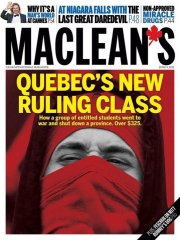
Why is the Left Freaking Out Over This Maclean's Cover?

Simply? Because it's true.

More than a little too true for their tastes.

All across Canada, it's been an impossible subject to avoid. Militant students in Quebec have taken to the streets in protest to a government plan to increase Post Secondary tuition in the province by $325 a year, each year for a period of five years.

Even after all the increases, Quebec would still have the lowest tuition in all of Canada. But that isn't enough for these students, who demand that somehow tuition be kept indefinitely frozen at a level far below what is needed to sustain Quebec's post secondary education system.

Normally, the left is all about "sustainable development." Unless they're the ones who have to sacrifice in order to ensure that things are sustainable. Then they're steadfastly opposed to it. But I digress.

Over time, the Quebec protests have turned more and more violent, more and more thuggish. Students who decline to go along with the protest have not only had their semester shut down, but have in some cases even been threatened by their more militant peers.

Even the Black Bloc has made the scene. And as Canadians grow ever more tired of the hysterics and thuggery overrunning Quebec's streets, the fever is spreading. The Montreal bus driver's union has voted to refuse to transport police officers to the scene of any riot, and to refuse to transport arrested protesters away from any riot.

Incredible.

Some aligning themselves with these students have even taken it upon themselves to produce this.

No one should be shocked that the left are so eager to attribute brilliance to themselves. It's just what they do. But the failure to address the simple criticism of the self-righteous sense of entitlement of Quebec students is simply astonishing.

 Even more astonishing is witnessing students who already pay more tuition than students in Quebec getting onside with Quebec's students, almost as if they imagine that if the Quebec government can be broken, so can their own governments.

All of this makes it clear that far too many students in Canada haven't come to grips with a simple, central fact about this issue: which is that someone has to pay for post secondary education.

In Quebec, to date, it's actually been whichever provinces may be considered a "have" province under Canada's equalization formula. In the past this has included Ontario, currently includes Alberta and Saskatchewan, and will eventually include Newfoundland and Nova Scotia.

So if students in Ontario, Alberta, Saskatchewan, Newfoundland and Nova Scotia were to demand the same tuition as Quebec, just who would pay for post secondary education in Canada? Who would pay for it if some of these activists got what they wanted and university tuition was free?

Thursday, May 24, 2012

Delivering the Death Blow to Thomas Mulcair's "Dutch Disease" Theory

NDP leader Thomas Mulcair is a man with a theory. And like many previous men with many previous theories, he isn't willing to get go of it.

His theory is that the strength of Canada's resource sector -- particularly the energy sector, especially the oil sands -- hurts Canada's manufacturing sector. In greater detail, he argues that exports of energy resources have "artificially" inflated the Canadian dollar, making manufacturing exports more expensive to international buyers.

When Mulcair first floated this thesis, response to it was fairly tepid. But it has slowly picked up steam, and revealed to Canadians precisely how ill-suited Mulcair is to become Prime Minister. Even as all the evidence disputing Mulcair's thesis has trickled out, Mulcair refuses to back down. No matter how many economists dispute his thesis, Mulcair simply insists that "everybody knows" that Canada is suffering from Dutch Disease. Despite the fact that this can immediately be seen to be untrue.

There was Jack Mintz in the Financial Post pointing out that the so-called decline of the manufacturing sector in Ontario and Quebec closely mirrors that of US rustbelt states like Michigan and Ohio -- two states that don't have booming resource sectors to blame for their plight. Then there was the Institute for Research on Public Policy pointing out that Canada has a mild case of Dutch Disease at best, and that the symptoms suffered by the sectors of manufacturing that have struggled can actually be attributed to their products, and to their failure to reinvest in capital. Mulcair simply pretended that the IRPP report supported his thesis -- it doesn't -- and pro-NDP hacks on Twitter attacked Mintz on an ad hominem basis. Neither is what anyone would expect from people who are confident in their own theories.

Now, Philip Cross has delivered the death blow to Mulcair's thesis, pointing out that a stronger dollar is good for Canada, and that the benefits far outstrip any harm that a stronger currency would do. Cross points to the addition of low-wage, manufacturing jobs in Canada during the 1990s -- manufacturing products such as textiles, clothing and furniture -- at a time when other countries were shedding those jobs in favour of adding high-wage jobs. It's certainly no coincidence that those are the very manufacturing sectors that are suffering under a stronger Canadian dollar.

It's in the wake of this particular point that it becomes clear that Thomas Mulcair never heard of a man that you may have heard of... a man by the name of Steve Jobs.

Steve Jobs was a person who never bothered making products of low differentiation and low complexity, even in compared to his immediate competitors. Nor was he a person who focused on making a product that was less expensive compared to his competitors. What the success of Steve Jobs, Apple, and their various products -- particularly the iPod, the iPad and the iPhone -- is that if someone wants or needs a particular product badly enough, they will buy it at a more expensive price. Certainly, nobody ever bought any of these products because they were less expensive. They weren't. Therein lies the shortest logical route in demonstrating Mulcair's thesis to be both shortsighted and foolish. And it applies to Canadian manufacturing just as much as it applies to resource exports.

In fact, the success of the oilsands, even with a stronger Canadian dollar, proves that people will buy what they need at a comparatively higher price if they want or need it badly enough. The United States badly needs Canadian oil. China badly needs Canadian oil. India badly needs Canadian oil. And they're all buying it, despite the strength of the Canadian dollar, and despite the detail that this makes Canadian oil more expensive for them to buy. As it turns out, the same has turned out to be true for Canadian manufacturing. Sales in most of Canada's manufacturing sectors have actually climbed, despite the strength of the Canadian dollar.

There's a reason for this: it's because in these particular cases Canada is making what consumers -- whether they're individual household consumers, companies, or entire countries -- want and need. And when that is the case, consumers are buying it despite any additional expense. This is what Thomas Mulcair clearly doesn't get: is that a lower Canadian dollar isn't a substitute for innovation in Canadian manufacturing, creating a quality product, or even simple competitiveness. It's been made clear that these are the things that are wrong with the sectors of Canadian manufacturing that struggle under a stronger dollar.

But Thomas Mulcair has clearly never heard of Steve Jobs. So Thomas Mulcair doesn't know that.